SOCIAL
CONTACT US
ADDRESS
©
E pluribus unum.
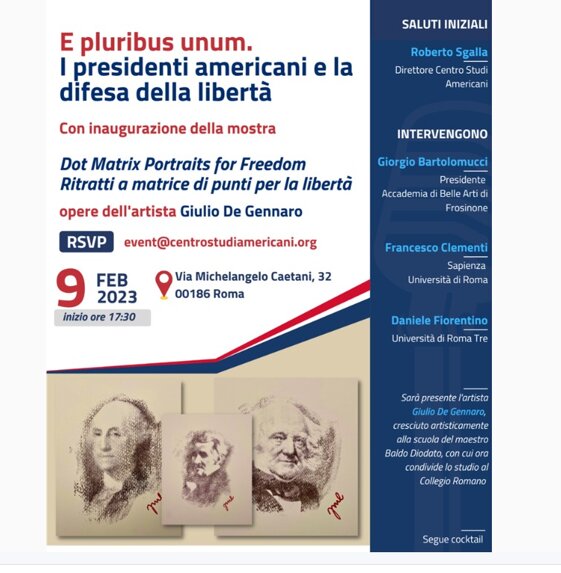
The artist has created, for the Centro Studi Americani, a collection of 13 dot-matrix portraits depicting, starting from George Washington, the first twelve presidents in the history of the United States, plus the portrait of Abraham Lincoln.
The idea behind the creation of these works stems from the desire to reproduce the optical effect of a lithograph, that is, a serial production, while at the same time restoring a craftsmanship to the graphic result that would otherwise be barely perceptible. Moreover, the particular structure of the ink that merges on the cardboard reflects an expressive intention made not only of voids and solids, that is, not exclusively binary, but on the contrary allows for gradation in the chiaroscuro, which, together with the overall sharp image, merges into a web of indistinguishable spots in detail. Bringing to the surface an overall vision of reality, in which every moment is collective and not a monad per se defined.
This multitude of dots, of spots, of segmented shadows, then becomes a tool at the service of the collective whole.
Dot Matrix Portraits for Freedom
"The dot matrix is a grid that generates images and graphics, based on the dots that are “activated” and “deactivated.” It is the principle underlying printing and many digital devices and presupposes active participation from the viewer, who is called upon to “recompose” these images divided into dots.
And it is precisely in the Divisionism of the late nineteenth century that we must identify the source of inspiration for this visual approach, precursor and forerunner of the pixels on the modern screen. In this regard, one cannot fail to mention Marshall McLuhan and his classification of media into hot and cold, depending on the degree of involvement they induce in the viewer. De Gennaro’s Divisionist portraits certainly fall within the realm of cold media, that is, those that have the viewer as the focal point. It is the viewer who is required to recompose the faces and recognize them. What currently differentiates De Gennaro’s approach from Seurat’s, beyond the technique of execution, is certainly the preference for black and white.
This, too, however, is not by chance. Black and white allows the artist to obtain, through the skillful and laborious use of overlays of inks and solvents, multi-level chiaroscuro, which gives body and substance to the images.
This is even more evident in the portraits of the Presidents of the United States of America created for the Centro Studi Americani, which hosts this exhibition. The chiaroscuro gives sculptural plasticity to these faces which, depending on the different angles of observation, really seem to emerge as if sculpted in marble or rock, according to the iconography well known to us all.
The message of these icons of freedom must also be carved in stone, that is, a message of peace, brotherhood, and progress, made even more urgent and necessary today by the war that has struck Ukraine. Here too, one cannot fail to recall Marshall McLuhan when he says that the medium is the message. In the technique of Divisionism, we find an invitation to set aside one’s own particular interests to consider oneself part of the whole. We are dots that make up a universe, and each of us can and must contribute to the harmony of the cosmos."
Lorenza Cariello (MAMBO - Museum of Modern Art of Bologna)
SOCIAL
CONTACT US
ADDRESS
©